2010
04.08
04.08

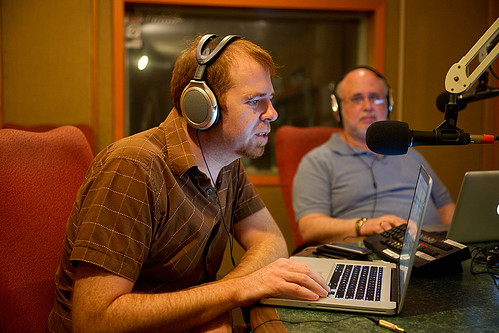
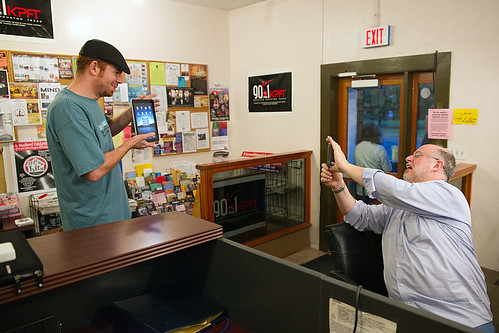
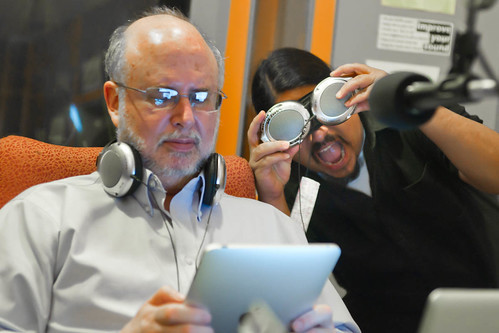
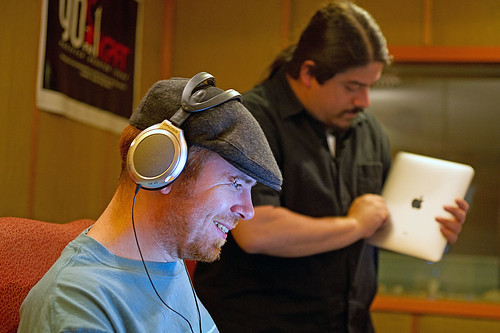
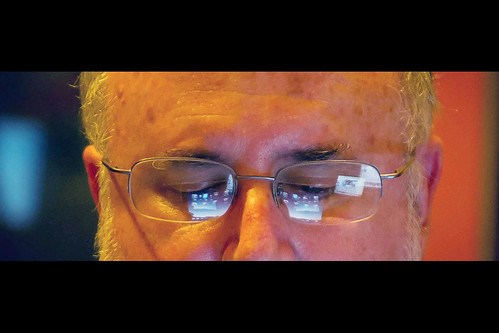
Tonight’s show featured a very special guest in the studio. The Apple iPad. Everyone was very excited!

We RTFM so you don’t have to | 8-10 p.m. Wednesdays, 90.1FM KPFT in Houston
Tonight’s show featured a very special guest in the studio. The Apple iPad. Everyone was very excited!
Spring has sprung and new life abounds. Unfortunately, not all of this new life is cute and cuddly. While the bunnies hopping along the bayou are harmless enough, the dust bunnies that grow inside your desktop computer can insulate electrical components and disrupt airflow within the case, significantly increasing the operating temperature of your system.
(I guess that would rank dust bunnies somewhere between actual bunnies and those of the Monty Python persuasion, which await you all with nasty, big, pointy teeth. The thing to remember is this: Keep clear of any cave entrances guarding sacred treasures, and the killer bunnies will keep clear of you.)
So, leaving the cave for the computer: electronic circuitry works most reliably at low temperatures. Higher temperatures can degrade and wear out any heat sensitive materials used in the electronic components, and fluctuations in temperature will stress many more components, causing them to expand and contract, wreaking havoc on the myriad of interconnects found on every circuit board in your PC.
Even more nefarious is something known as ‘metal migration’. This is especially prevalent in areas where high temperatures are combined with high humidity. I personally don’t know any place like that, do you, Houston?
Metal migration occurs when metal whiskers or dendrites grow from the conducting lines of a circuit board. With lines being spaced closer together in today’s devices, shorts between lines can occur, causing component failure and the untimely demise of your PC.
While there’s no immediate cure for metal migration, you can combat dust bunnies with some carefully aimed bursts from a can of compressed air. Don’t make the mistake of blowing any visible dust on external fans inside the case; you’ll need to muster up the courage to open your computer’s case for this job.
Before you crack your desktop’s case, you’ll first want to unplug everything, paying close attention to what went where. Opening your computer case can require anything from the simple press a tab to performing a certain series of knocks and bumps that would just as soon grant you passage to Diagon Alley as it would open your case. When in doubt, get online and search for the instructions on opening the case to your particular model of PC. Trust me: three minutes of Googling is roughly equivalent to ten minutes spent super-gluing broken bezels and tabs back into place…
Be careful not to unseat anything or tug on any wires that would loosen something. Actually, this is a good time to take a look inside your computer and try to identify all the major parts. Again, a quick search for ‘schematic’ and the model of your PC should turn up what you’re looking for. Of course, you don’t want to do this from the computer you’ve got opened up. If you don’t have a second computer around, print them out for handy reference before open the PC.
If you have pets or smokers in close proximity to the PC, you may even want to take the PC outside for this, as smoke and pet hair act like dust bunny steroids. Who knows, you may have a bunny who can bat .400 in there…
Aside from removing any obvious animal life from the PC, you’ll want to make sure that both the fan over your PC’s processor and it’s power supply are clean. If the situation is really bad, you can brush debris off the fan blades, away from the processor or power supply. After that, you’ll want to blow them out with your can of compressed air. Since it’s possible to damage your fan by spinning the blades too quickly as you apply the compressed air, keep them in place with the end of a plastic disposable pen, cotton swab, or something similarly non-conductive.
Blow off any exposed circuit boards, taking care not to get too close to the boards with the air, as pressurized air has been known to dislodge shoddily affixed chips and components. If there are any coffee or soda stains in the base of your PC, first, count yourself very lucky that you still have a running PC, and second, get a slightly damp cloth to scrub them away.
You can also inspect components to make sure that everything is properly seated, or plugged in securely where its supposed to be plugged in. The schematic for your PC will help out with this. If you do need to physically touch any components inside the PC, make sure to touch something metal on the case first, to discharge any static electricity that may have built up on your person. Once everything has been dusted and it looks like a new PC on the inside again, its time to put everything back together and power it up.
If something came loose during your dusting, an error message will generally display on the BIOS screen or you may hear a series of beeps before its even able to get that far. Opening your case again and checking to make sure that everything is properly seated will generally fix the issue.
And if that doesn’t do it, you can just call it quits and head to Austin this weekend for Texas Linux Fest 2010. Happening this Saturday, April 10th, at the Marchesa Hall and Theater, the Texas Linux Fest is a one day event bringing Linux visionaries and gurus together with Linux enthusiasts from across the state of Texas and beyond. Jon “maddog” Hall will be on hand throughout the con, as will a number of notable guests, speaking on things like monitoring large scale Linux systems with OpenNMS, the Drizzle Database, Security Enhanced Linux for Mere Mortals, Ubuntu on the Arm processor and even a talk on Unicode. If you’re on Mac or Linux and you’ve ever noticed the
diamond-question-marks in place of oddly accented characters, this talk is for you.
I’ll be in attendance, so be sure to say ‘Hi’ if you head that way. Hit
www.texaslinuxfest.org for a schedule of panels, directions to the venue and details on registration (which they have made extremely reasonable for those who may be on an open source software style budget).
That’s it for this dust-bunny death-match and that’s that for BarretTime.
The good folks at Blendtec wasted no time answering the question that is at the top of the list of those considering purchasing the new Apple iPad…
The Texas Linux Fest is coming up in just a few weeks. Happening Saturday, April 10th, at the Marchesa Event Center in Austin, Texas, the Fest aims to be the first state-wide, community-run conference for Linux and Open Source Software enthusiasts. Jon ‘maddog’ Hall will be on hand, along with a number of other notable Linux speakers. Talks and Panels cover topics such as Apache Cassandra, building your own Mail Cloud, Drizzle, OpenNMS, Security Enhanced Linux, and the Ubuntu Enterprise Cloud.
Admission is inexpensive and both enthusiast and supporter level tickets may be purchased, depending on your particular economic situation.
Hit www.texaslinuxfest.org for a list of talks and a link to the registration page.
This coming Tuesday, the 1960 PC Users Group will be holding their monthly general meeting in conjunction with the monthly meeting of their Digital Photography SIG.
The general meetings are generally short and are generally used to recognize visitors, make announcements, and give attendees a little social time, complete with refreshments, before the start of the meeting. Six thirty to get your blood sugar up and seven o’clock to level up your intelligence. The Digital Photography presentation immediately follows. April’s speaker will be Don Townzen, who, over a period of three years, travelled the state of Texas to photograph all 254 of the state’s court houses. He’ll be sharing these pictures along with bits of Texas history and folklore, with his photographic traveling partner, Pat. Your digital photography questions will be answered, too. All of this happens Tuesday, April 6th. Hit www.1960pcug.org for details and directions. The Digital Photography SIG has been posting past presentations in PDF format to their SIG page, so be sure to take advantage of that resource if you’re just starting to get up to speed with digital photography.
And tomorrow morning, you’ll want to surf sites like Slashdot.org and ThinkGeek.com with an air of suspicion, as it will be April 1st, aka April Fool’s Day. Since the dawn of the Internet, there have been those who would deceive on this day, in mostly clever and harmless ways. Rather than try to pull the digital wool over your eyes tonight, I’d rather revisit some of the better pranks from April first’s past.
Last year, YouTube allowed users to turn videos upside down by including flip=1 in the GET string of the video’s URL, turning several unaware users’ worlds upside down. That may have looked just about right to users of Google in Austrailia, who may have been temporarily enticed be the gBall, a football containing a GPS and motion sensing system used to monitor the location, force, and torque of each kick. 2009 was also the year that the UK’s Guardian stated that they would be killing their print version and going to a Twitter-only format.
In 2008, the Aussies are back at it with a claim that the new Google search tool could search into the future. YouTube also made a notable showing by RickRolling all of their featured videos that day. The Weather Underground stated that psychic research had proven the connection between hurricanes and global warming, which could have extended some credibility to a BBC video produced by Terry Jones, in which the film maker discovers a breed of flying penguin that migrates to the rain forest when things become a little less than pleasant in their wintery summer homes.
In 2007, Think Geek dropped a few new products on the market, such as the Wii Helmet and the 8-bit tie. In Their defense, Think Geek did eventually bring a real, live, 8-bit tie to market which is now available the other 355 days of the year. Google.com offered up free in-home wireless broadband, and hideapod.com offered up the ultimate iPod anti-theft device… by hiding it in a Zune. (Zing!) And having apparently missed the fallout from the bonsai kittens, or perhaps paying very close attention, the site tattooyourtoddler.com caught some flack from a few child protection organizations who had failed to check their calendars. This was also the year of the virtual tin foil hat, as it was introduced as an in-game item by Blizzard in the World of Warcraft.
In Aught-Six, the Fair Use Day.com team announced that they had joined the ranks of the RIAA, Fidofinder.com offered up a one million dollar reward for a lost dog, and iwantoneofthose.com featured a tiny device that would allow you to download your brain’s memory onto a 2GB USB flash drive. Surfers who bought that probably could have gotten away with the 500MB model.
In 2005, Google released Google Gulp, allowing you to quench your thirst for knowledge. The Auto-Drink feature and the fact that it was low in carbs were two strong selling points. Our own Chron.com was among the first to pick up prank that Maxim magazine would feature the Bush twins on the front cover, clad in lingerie, in what would appear to be the aftermath of a pillow fight. And in a one-two-punch combo on the Bush clan, SpaceDaily.com announced that Bush had canceled the Space Shuttle program.
And all the way back in 1998, an issue of the New Mexicans for Science and Reason newsletter contained an article claiming that the Alabama state legislature had voted to change the mathematical constant pi from 3.14159… to the ‘Biblical’ value of 3.0. The newsletter soon made its way onto the web, resulting in hundreds of letters to the Alabama legislature demanding they repeal the bogus bill.
The site aprilfoolsdayontheweb.com has a pretty good compendium of April First web shennanigans dating back to 2004. They’ll also be tracking tomorrow’s 2010 fare in near real time, so rather than circularly surfing sites, just use them as your single prank portal.
And if you’re not already in the habit of doing so, tomorrow is an excellent day to start locking your desktop when you leave for a coffee break, lest you fall prey to a local prank at the hands of co-workers.
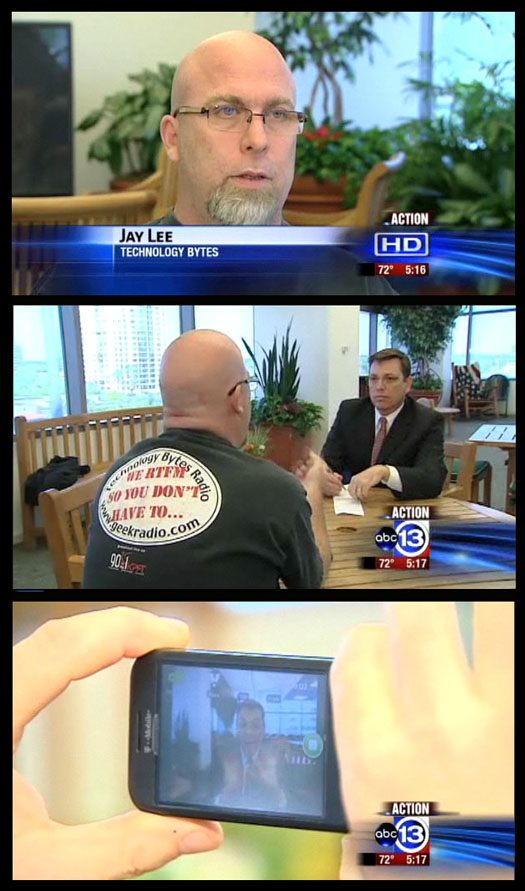
And finally, Friday, April 2nd, is the date of the April Installment of the monthly Geek Gathering. That’s no joke, though tales of the previous day’s antics won’t be turned away. We’ll be carting out an epic amount of Arduino gear in the hopes that we’ll have enough room next door to let people get the hands dirty with physical computing. If you have any of your own projects you’d like to show off or if you’d just like to work on something in the presence of kindred souls, then we invite you come on over and set up shop. The Coffee Groundz is located between Brazos and Bagby on McGowan in Midtown Houston. WiFi and geeky camradery are free, but coffee, beer, spirits, gelato and food will set you back a few bucks. Things get started around seven and are buzzing until the last geek isn’t. Which is always after ten. So join Jay Lee and the rest of the crew of Technology Bytes to get in on the action, be it digital or something made with some 100 gram heavy worsted Merino wool. Knitting reference for the win!
That’s it for your 4/1 411 and that’s that for BarretTime.
First off, today is Ada Lovelace Day, an international day of blogging to celebrate the achievements of women in technology and science. www.findingada.com for details on the day and the lady.
This weekend, Houston’s George R. Brown will be home to Comicpalooza. In its third year, the con has been re-invented as a multi-format convention celebrating not just comics, but also sci-fi and fantasy, horror, steam punk, New Media, movies, film, and gaming of all types. www.comicpalooza.com for details and registration information.
Also, the Texas Linux Fest is coming up in just a few weeks. Happening Saturday, April 10th, at the Marchesa Event Center in Austin, Texas, the Fest aims to be the first state-wide, community-run conference for Linux and Open Source Software enthusiasts. I don’t know how LinuCon from a few years back would factor into that, but this is definitely the first state-wide Linux conference to open with a musical morning keynote.
Delivered by Joe “Zonker” Brockmeier, ‘A Musical Guide to the Future of Linux: Reprise’ will take a look at where the Linux community is, where its going, and maybe where it should be going next. Along the way, Zonker plans to show you that Open Source has more in common with popular music than you might think.
Talks and Panels cover topics such as Apache Cassandra, building your own Mail Cloud, Drizzle (the database, no relation to Snoop Dogg, yet), OpenNMS, Security Enhanced Linux, and the Ubuntu Enterprise Cloud.
For all of the developers out there, you should probably pencil in the talk being presented by Janet Swisher and David Cramer entitled, ‘Benefiting from the Skills of Non-programmers’. If you just muttered ‘what skills’ under your breath, then you should probably go ahead and ink that in.
And it wouldn’t be a Linux festival without talks of installing the OS on things other than your garden variety IBM clone. ‘Linux on the PowerPC’ and ‘Ubuntu on ARM’ are two talks that fill that niche. If you want to develop for mobile platforms but don’t want to deal with the lock-down of the iPhone App Store or the awesomeness, I mean, well, you’re going to have to Google for a con of the Android platform because I’m still in love with my Nexus One, so long as Google is legally allowed to call it that. The point is that if you want to run Linux on your older Apple or Ubuntu on your ARM-powered mobile device, these talks have you covered. By the way, I mean ARM powered as in products powered with the ARM chip, not your own arms, as would be the case with our hand-crank radio of fundraisers past.
ARM is a 32-bit reduced instruction set computer, which is commonly known by the acronym RISC. The chip started out life as the Acorn RISC Machine, but underwent a name change to the Advanced RISC Machine.
In 2007, 98% of the more than one billion mobile phones sold used at least one ARM processor. Today, products like the Acer n300, the Amazon Kindle2, several of the Dell Latitude e-Series laptops and the Microsoft Zune HD all use ARM technology. So Ubuntu getting into ARM is certainly big as far as freeing the next generations of mobile devices.
So getting back to all things Linuxy, Linux Legendary Jon “maddog” Hall will be on hand at the Texas Linux Fest to talk about Project Caua, a project aimed at making it possible for people to make a living as a Systems Administrator or Entrepreneur using Free and Open Source Software and Hardware.
Randal Schwartz will be wrapping things up with a talk titled, ‘Free Software: A Look Back, a Look Ahead’ in wich he’ll be recounting some of his experiences with the history of free software, including why it works, how to contribute, and how to make money with it.
It will cost you some money to attend, but both enthusiast and supporter tickets may be purchased, depending on your particular economic situation and dedication to the scene. The supporter ticket also comes with a bag for schwag and a t-shirt. Other than that, they badges are identical.
Hit www.texaslinuxfest.org for a list of talks and links to the registration page. Again, that’s Saturday April 10th.
A little closer to home is the second of two presentations by the Houston Linux Users Group aka the Linux SIG at HAL-PC. Things get going at two in the afternoon at the HAL-PC Headquarters and are generally wrapped by four. Hit www.hal-pc.org for directions, then follow the link for viewing the complete SIG and Class Calendar. While you’re there, you can check out other Special Interest Group goings-on, such as the Robotics Lab that meets at 1:00 that same Saturday, or the Linux Workshop, which meets every Wednesday night at six PM at that same location. Aside from the Geek Gathering, I know of no other groups that invite you to bring your Linux problems in hardware form, along with you to a meet-up. But these guys encourage it. Just make sure to bring all the appropriate power cords, keyboards and mice. Really, everything but the monitor. And they’ll have you in the car in time to catch us, hopefully with less Linux questions than you started with.
I mentioned Project Caua earlier. The group has some fairly lofty goals that include creating millions of high tech jobs in the private sector, saving huge amounts of electricity from desktop computers, creating environmentally sound computing, making computers easier to use, and bridging the Digital Divide by creating a free wireless mesh bubble over areas of high population.
They also believe that annoyances of today like viruses, SPAM, making backups and even installing software should all be things of the past. A little less ethereal is the project’s idea to transfer oversea support jobs to unemployed people here in the US. The project believes that there are perfectly capable people who are currently on welfare that just need to be trained to do a job well and given backup support when needed. The underlying technological theme is that all of this can be done with Free and Open Source Software and Hardware. Its out there, its free, we just need to get it in the hands of the people who can benefit from it. That’s a tall order, but you don’t earn the nickname “maddog” by chasing things that are easily caught.
Hit www.projectcaua.org for more information about this group’s lofty goals.
And lastly, we have a Geek Gathering coming up in a little over a week. And while we’ve definitely hiked in a large amount of Arduino gear in meetings past, we’ll be doing doubly so a week from Friday. The Arduino platform revolves around the idea of taking a low power micro-controller, something akin to what would have set on your desktop twenty years ago in terms of power, but no bigger than a stick of chewing gum in terms of size, making it easy to tie in any assortment of electronic inputs and outputs. In the end, Arduino can mean anything from wearable computing to audience-aware art installations. And at April’s Geek Gathering, we can show you the gear that
will allow you to take your first steps into becoming a maker rather than a user. That’s it for getting a Lasso on Linux in the Lone Star State and that’s that for BarretTime.