web analytics
2011
07.05

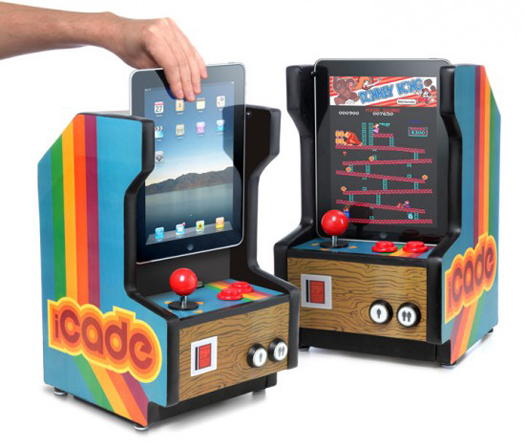
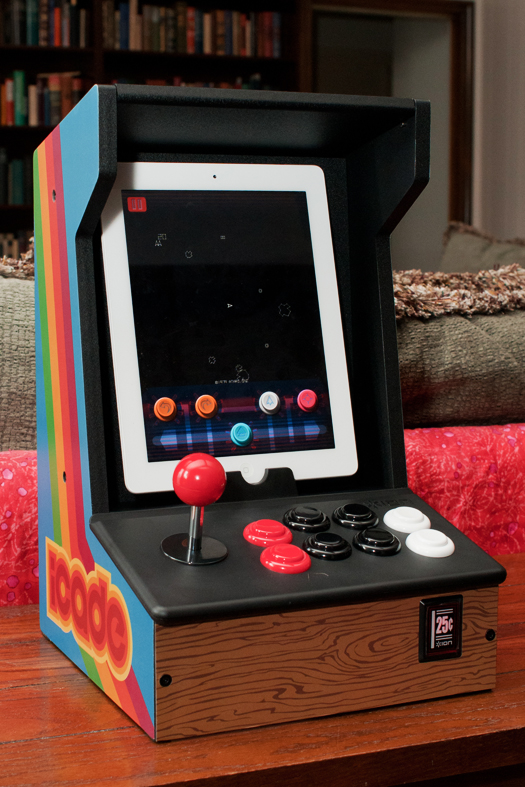
iCADE Gaming Cabinet for iPad

Here on Technology Bytes we always take great joy in reporting the various April Fools jokes perpetrated by the various tech sites around the Internet. One of the more popular was an item advertised at ThinkGeek as the iCade. A device that would turn your iPad into a retro Atari gaming console. This was April Fools Day 2010.

The fake device received a LOT of attention, even from other tech sites. SlashGear called the iCade a “fake with real promise.” Engadget editor-in-chief Joshua Toplovsky tweeted out “man, I SO want the iCade to be real!” Waxy said it was “particularly cruel, because it’s an awesome idea that needs to exist.”

Fast forward to, well…now. ThinkGeek has actually made the iCade a reality.

The iCade is a really clever device. It doesn’t actually plug into you iPad. It connects as a bluetooth device that is paired with your iPad.

Once you assemble the iCade (comes with necessary tools, much like a piece of Ikea furniture) you simply follow the instructions to pair it with your iPad.

You will need to download the Atari Greatest Hits from the Apple app store. The free version contains Missile Command. For an additional fee you can purchase additional games. There’s everything from Asteroids (and Asteroids Deluxe) to Swordquest. 18 classic Atari arcade games and 92 Atari 2600 games. 100 in all.

The iCade is pretty solid and the controls work well enough. It does take a little getting used to being so small. But it is a real hoot and quite a trip down memory lane.

2011
07.01

BarretTime for June 29, 2011

All right. Technology Bytes has been here for sixteen years, and, as the old saying goes, the more things change, the more they stay the same. So what has Technology Bytes had to contend with over the years? 1995? Is that the year? We’ve got Internet Explorer 1.0, the birth of Ebay and Hotmail, Java and Javascript, Windows 95 and PHP, as well as the introduction of the venerable ATX motherboard form factor from ATX.

Netgear was founded in 1996, known for more than a decade for their blue metal boxes. This is the year that personal computing power hit an all-time high as Intel released their 200MHz P6 chip. Duke Nukem 3D hits the shelves and the domain name myspace.com is registered. HTTP/1.0 becomes a standard and the IMDB makes the hop from Usenet to the web. Google also gets is start in 96, and Creative Labs drops the first dedicated gaming graphics card, the 3D Blaster.

Dr. Thomas Pabst creates the website, (any guesses?) Tom’s Hardware.com and Apple stock hits a ten year low at a valuation of $18.00 a share.

In 97, the Internet2 Consortium is established, AOL gets sued by subscribers with connectivity issues, the Intel Pentium II ups the processor ante, and CD-RW drives and readable/writable media are introduced, heralding the death of the mix tape. Bill Gates becomes the world’s riches businessman and steps in to save Apple with a $150 million dollar bailout investment on August 6.

Internet Explorer 4 and Microsoft Office 97 are released shortly before Windows 98 is announced. This is also the year that WiFi arrives. Slashdot comes online, as does Hotmail. At this point in History, both sites are Linux related… 😉

In 1998, online web journals or Blogs start to hit the web and congress, much to the dismay of technologists everywhere, passes the Digital Millenia Copyright Act. This is the year that Bill Gates is hit in the face with a cream pie and people across the world start to donate their spare processing power to help in the search for extraterrestrial life with Seti@Home. Windows 98 is Released on June 25 in *1998*, and MS IE passes Netscape in Internet Browser Market Share less than 20 days later. Funny how bundling a browser along with an Operating System will put you ahead like that. This is also the year that Microsoft goes to court over anti-trust concerns.

On the Open Source Side, MySQL is released. And on the non-free side, Paypal comes into existance, as does Rockstar Games. Hot Coffee, anyone?

In 1999, RIM realses the Blackberry and a Victoria’s Secret fashion show becomes the first major webcast on the web with over 1.5 million viewers. Wiki’s hit the web this year, and the Relational datbase management program Access becomes MS Access. And gamers rejoice as Nvidia introduces the GPU. Naptster is sued by the RIAA and Amazon’s Jeff Bezos is named Time Person of the Year.

In 2000, the world trudged on after the very uneventful Y2K event. Twitter.com comes online this year, and EA releases the SIMS. Win2K hits and ATI introduces the Radeon line of graphics cards. And only two short years after legal proceedings began against Microsoft, Judge Thomas Penfield announces that Microsoft be split into two companies. Of course, this didn’t happen, but it was a nice gesture, all the same.

In 2001, Wikipedia starts ammassing user created content, and we start to lose the first of our living computer history with the passing of William Hewlett at 87 and Claude Elwood Shannon. Shannon is known for his work in the 40s at Bell Labs as he laid the foundation for modern information theory. He was 85. With the old guard gone, the Code Red worm also starts wriggling through the world wide web and Dell continues to thrive, becoming the world’s largest PC maker during a fifteen year low in computer sales. Apple’s OS 10.1 comes out. Does anyone remember the codename? Puma. Serial ATA and USB 2.0 are introduced and Microsoft decides to kill off Clippy shortly before the release of Windows XP. I still pour out a sip for the Clip every time I drink and work with MS Office docs… I hope you do, too. And after producing the last fireball, Qantum sells off its hard drive business to Maxtor. This was also the first year you could stumble upon stumbleupon.com. Oh, and one more thing. The iPod. Yep.

In 2002, Dean Kamen unveils the Segway. Have we ever had any Segway support calls? I guess George Bush wasn’t a fan of the show at the time. PCI Express is approved as a standard and Roxio picks up the Napster name at a bankruptcy auction.

In 2003, The Smaller worm does it’s thing and becomes the fastest spreading work in history after infecting hundreds of thousands of computers in it’s first three hours of life. SCO becomes the target of everyone’s ire as it sues IBM for its alleged contributions to the Linux kernel. Apple opens the iTunes store, and LinkedIn launches. This is the year that Skype goes public, and Apple releases OS X 10.3. Panther.

In 2004, the Official MySpace site launches, though still managing to hold onto a look that predates it’s domain name registration. Mark Zuckerberg launches TheFaceBook, which is later shortened to just FaceBook. And on April 1st, Google announces the creation of GMail, which many percieved as a joke. Sorry, Hotmail. And modern warfare truly enters the information age as the first five human beings are killed by an unmanned ariel vehicle or UAV in South Waziristan on June 18. OK, that’s definitely a bummer, but something insanely great did happen that year, the release of OS X 10.4 (codenamed? Anyone? Tiger!) just ten days later at the World Wide Developers Conference. Ubuntu 1.0 is released, as is the game World of Warcraft. In terms of the balance of good and evil, this one’s a wash. This is also the year that the numbers 4, 8, 15, 16, 23 and 42 enter our collective consciousness.

In 2005, we all become a little less lost, as Google Maps is introduced. And we’re all given a video voice as YouTube comes online. Does anyone remember the title of the first video uploaded? Me at the zoo. And speaking of 800 pound gorillas, Apple announces that it will leave IBM for Intel as the main supplier of chips for its personal computing line. Microsoft swaps the name Longhorn Windows Vista and IBM halts sales and support of it’s own Operating System OS/2.

In 2005, the XBox 360 hits store shelves, ushering in a new era of Internet connected gaming consoles. And while everyone else is out buying XBox games, Yahoo buys Flickr, News Corporation buys MySpace, eBay buys Skype, Adobe buys Macromedia, Yahoo! buys del.icio.us and Seagate buys Maxtor.

Blu-Ray brings in 2006 as Wikipedia publishes its millionth article. Toshiba releases the first HD DVD player as Apple announces BootCamp. Twitter is officially launched, lengthening its name from Twttr, though still restricting users to 140 characters. Cloud computing comes of age as Amazon Web Services fire up for the first time. Nintendo launches the Wii as Sony releases the Playstation 3. And Time Magazine names *Me* as the Person of The Year. Well, actually, it was you. But me just sounds better.

In 2007, Apple announces that it will drop the “Computer” from it’s name, as it becomes a company that deals with more than just computers. Apple then announces that it intends to stick the letter “i” in front of every common word Steve Jobs could write down in the 24 hours before the release the first iPhone at the Macworld Conference and Expo. Things get twice as nice this year, as Intel drops the Core2 Duo. Of course the cpu-hungry Microsoft Vista and Office 2007 are there to eat up any spare cycles you may have left over from the extra proc. And Google shows us what we look like from a smart car as Google Street View is folded into Google Maps. Google continues to have a big year with the release of Android, and Amazon starts to change the publishing game as it starts to sell the Kindle along side its books in print. Aplpe releases OS X 10.5. Codename? Leopard.

In 2008, the Blu-Ray HD DVD wars come to an end as HD DVD throws in the towel. Hopefully not the towel they got from the industry that helped push Blu-Ray into the winner’s circle…

In 2009, Google produced a shiny new browser, Chrome, and Microsoft hits back with the release of Internet Explorer 8. Microsoft announces the Bing Search Engine and Google announces the morphing of Grand Central into Google Voice. Microsoft inks a ten year deal to replace Yahoo! search with Bing and after 5 years, Gmail finally gets out of Beta. And not to be outdone by anyone, Steve Jobs is named CEO of the Decade by Fortune Magazine. Oh yeah, and Barnes & Nobles release the Nook.

In 2010, Apple produces the iPad and Google gives us Buzz. And in contrast to our military milestone, the first all-robotic surgery is performed in Montreal.

And in 2011, Watson beats the two highest ranked Jeopardy players, thus replacing the holy grail beating human chess players with that of beating game show contestants.

And here we are. Duke Nukem still looks like Duke Nukem, we still live in a world without Clippy, and I still don’t have my flying car. Maybe in another 16 years IBM will produce a computer that’s really good at Monopoly. Or dodgeball.

That’s (about/been) it for the Bed music and that’s that for BarretTime.

Of course, we still need to talk about the Geek Gathering. It creeps me out a little to do BarretTime without the BarretTime Bed Music. I feel like it’s kinda up to me to keep the baseline going…
2011
06.30

Podcast for June 29, 2011

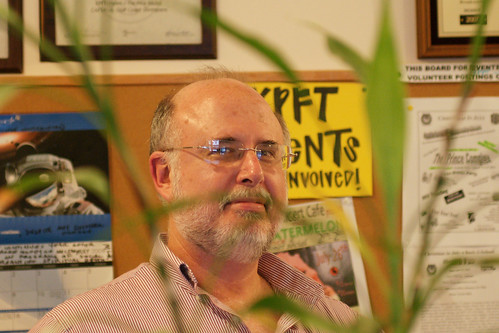
Dwight in the foliage

2011
06.24

Technology Bytes As Art

One of our listeners (Ryan Hay) has taken some audio samples from the show and put them together in to an auto-tuned montage. The result is, well…interesting.

Michael outdated by rhay777

2011
06.23

Podcast for June 22, 2011

2011
06.16

Podcast for June 15, 2011

2011
06.15

BarretTime for June 15, 2011

All right. The summer is continuing to heat up, but so is the list of available geeky summer activities. Things get underway with the Houston Super Secret Science Club meetup, happening tomorrow night at 6:45 PM at the Shepherd School of Music at Rice University. Unless that was supposed to be a secret… Well, the cat gut is out of the bag, as it were, because the Super Secret Scientists aim to explore the mind through music tomorrow night as they get together to attend a number of talks hosted by Rice University.

Reservations aren’t required and seating is first-come-first-serve. The Club will be meeting outside of room 1131 at 6:45 PM, where you’ll want to track down the head secret scientist, Steve. Over the course of three hours, attendees will choose between two sets of talks, one geared toward science, and the other geared more toward music.

Some of the science talks include Amy Hoover’s “Functional Scaffolding: A New Principle for Enabling Computational Creativity in Music”, John Iversen’s “Neural Dynamics of Beat Perception” and Rebecca Lepping’s “Development of a Validated Emotionally Provocative Musical Stimuli Set for Neuroimaging Studies of Depression”. Guy Madison will take a look at some rhythmic properties of Music that are correlated with groove – or the tendency for music to induce movement. Michael Schutz will examine the benefits of moving to the beat while listening to music, and Sherman Wilcox will spend some time looking for the link between Music and Sign Language.

Back on the music side of the school, in room 1133, Benjamin Anderson will talk about the fact that Elton John can write a song in less time than it takes most of us to make a sandwich when he addresses “Schemata and Elton John’s computational practice”.

If you feel the need to Crocodile Rock out, you may want to attend “Negentropy for solo flute: A compositional and perceptual study using variable form,” featuring flutist Izumi Miyahara. You can then follow that up with Shannon Layman’s talk on “Differentiating Rock from Bach” and how the identification of mainstream recordings requires only brief excerpts. Shazam!

All in all, it sounds like a solid night of science and music for both Tiny Dancers and Rocketmen, alike. For details and directions, surf to meetup.com/Houston-Secret-Science-Club. Of course, if the secrecy of the site proves to be impenetrable, or if you just can’t get the hyphens right, you can hit music.rice.edu, too.

If anyone does attend, please ask them how to purge all of these Elton John songs from my subconscience. Seriously… Please, don’t let the sun go down on me with “Candle in the wind” stuck in my head.

That’s just about as scary to me as Linux Kernel Internals may be to some of you. And while my situation may be hopeless, yours certainly isn’t. At least with the help of TxRx Labs and this Saturday’s three hour class designed to give you an Introduction to Linux Kernel Programming. The class takes on Linux kernel development with an eye towards creating your own kernel module or device driver and towards tricks and tools of the trade to make interacting with the Linux kernel development community go smoothly.

Hit www.txrxlabs.org for registration information on the last in their first summer series of classes.

If this scenario still sounds a little nightmarish to you, then you’re nearly fully prepared for Apollocon, Houston’s Science Fiction, Fantasy and Horror Conference, taking place at the end of the month at the Houston Intercontinental Airport Double Tree Hotel. In addition to the strong Sci-Fi, fantasy and horror fare, KD5 and I will be hosting a panel on the Maker Movement, as well as a two-hour workshop aimed at the Arduino. We’ll be providing the code and the kits, while attendees are asked to bring a laptop, an Arduino, and the necessary cable to connect them. If you’re new to the world of Physical computing, this workshop will give you the knowledge to make stuff move, blink and and make sound. Hit www.apollocon.org for details, directions and con registration information.

And lastly, we have a very special Geek Gathering coming up in July. Our Sweet Sixteen Party is taking place on July 1st, and even though we’re keeping things quiet, attendees are invited to Geek, Nerd or Schoolgirl it up.

We’ll have more details next week, but for now, that’s it for the passing of the Elton John & Con Batons and that’s that for BarretTime.

2011
06.09

Podcast for June 8, 2011

Bonus behind the scenes video from inside the studio!

2011
06.08

BarretTime for June 8th, 2011

Allright.

We’ve been on a BarretTime hiaitus the last three weeks, but I’m back with a couple of activities to keep you busy until the next Geek Gathering rolls around.

If you find yourself too caught up in the digital world and are in need some time to get back in touch with your softer side, you can head over to TxRx Labs this Sunday, June 12th, to take their two hour intro to painting class. The class explores the fundamentals of the materials and techniques of painting. Multiple mediums and styles will be discussed, along with proper storage procedures.

Also taking place this Sunday from 3:30 to 6:30 PM at TxRx Labs is an electronics workshop.

This lab provides electronics enthusiasts access to TX/RX Lab’s professional electrical engineers to assist in completing and trouble shooting their projects. Participants can use TX/RX’s fully outfitted electronics workshop to work on their project while being able to obtain guidance and aid from experts with decades of expertise in electronics design and construction. Participants may also use this time to get instruction on advanced techniques in soldering, troubleshooting, and the use of electronics test equipment.

Both classes require a small tuition fee that can be taken care of online at www.txrxlabs.org/classes/

Swinging back to the free side of things:

If you’re an existing Android developer or are interested in taking the first few steps down that path, you’re in luck. Houston’s first Android Developers Meetup is taking place on the evening of Tuesday, June 28th, at the Zebec Center near Westheimer and Fountainview.

The Houston Android Developers Meetup (or HADM, as I will refer to it for the remainder of the segement) will hold their inaugural meetup to delve into the new Arduino offerings that allow Android Developers to tap into the physical world when writing applications for their Android smartphones. I’ve got a board on order from Seeed Studios, so regardless of whether or not we GETM before HADM does, we’ll hopefully HAVM out at the July Geek Gathering.

If you’re unfamiliar with the Arduino platform, but want to remedy that before HADM meets, you may want to stop by Apollocon the weekend of June 24th for a crash course workshop on the subject. David Brummel and I will be hosting a panel on the Maker Movement and then following that up with a two hour workshop workshop focused on building things with the Arduino platform. Participants are asked to bring their own Arduino, USB cable and laptop to the workshop, where they’ll spend two hours working through nine mini-projects that David and I designed.

Seating space for the Arduino Workshop is limited, so you’ll want to reserve your spot early by surfing to www.apollocon.org. Apollocon, Houston’s own Science Fiction, Fantasy, and Horror Convention, is actually offering a Geek Track in addition to its more traditional fare catering to writers and readers of sci-fi and fantasy. Hit www.apollocon.org for registration info as well as a listing of the con’s other events.

Also taking place on June 24th from 8:00 AM to 4:00 PM at the American Society for Training and Development, Houston. The conference, while aimed primarily at individuals involved with training in their organization, includes topics of wide appeal, such as Cloud Computing, Second Life, Serious Gaming, Shooting video for training, and much more. They Keynote is titled, “Mobile Learning and the Mobile OS Wars: How to Avoid Getting Caught in the Crossfire”, which shows the slant the day’s events. For registration info, hit www.astdhouston.org and for the Houston Android Developers Meetup, surf to www.meetup.com or hit the geekradio website post-show for a full list of links.

That’s it for your summer session sylabus and that’s that for BarretTime.

2011
06.02

Podcast for June 1, 2011