web analytics
2011
02.02

BarretTime for February 2, 2011

Allright. The data is in from 2010, so we’ll get right into the numbers:

107 Trillion. Anyone? Our new fund raising goal next time around? No. Actually, it’s the total number of emails sent in 2010, which works out to an average of 294 billion messages a day which are distributed to nearly 1.9 billion email users worldwide. That’s an increase of over 34% in the number of email users in 2009, or a total of 480 million new users.

Now, you can’t talk about email without talking about SPAM, as SPAM made up the bulk of 2010s email server load, at roughly 89.1% of the total volume. That’s 262 billion unsolicited commercial emails per day.

And speaking of commerce, of the 2.9 billion email accounts worldwide, 25% of those are corporate.

Does anyone have guesses as to the number of websites on the ‘Net as of December 2010? We can quickly see who surfs NetCraft.com on a regular basis.

255 Million, with 21.4 million of those sites having been added in the last year alone.

Of the quarter of a billion web sites out there, 151 million of them were served to us by Apache, 56 million by Microsoft IIS, an impressive 16 million by Engine-X, and another 15 million by Google’s GWS or the Google Webserver. Incidentally, Microsoft’s IIS had stood for Internet Information Server for the majority of its life, but 2010 saw Microsoft really push the new moniker, Internet Information Services. A clever bit of re-branding, I dare say. And nearly as mispronounceable as “Engine X”, which is spelled “N G I N X” is the relative newcomer wrapping up 2010 with just half a percent of websites served, the contender spelled: L I G H T T P D. Cleverness compounded in this case, as it mixes the word Light with HTTPD or the Hypertext Transfer Protocol Daemon. Any guesses on how to pronounce it?

Lightly. Yeah. However it looks to you, ‘Lightly’ saw the largest growth in the web server arena in 2010 with a 55.7% increase in the number of sites hosted since the year before. Apache follows with 39.1% growth, and IIS is in third place with 15.3% growth.

2010 also saw an increase in the number of registered domain names. The numbers aren’t quite in for all of 2010 yet, but as of October 2010, there were over 202 million domain names across all of the top level domains. That breaks down to 88.8 million .COMs, 13.2 million .NETs, and 8.6 million .ORGs. There are roughly 79.2 million country-coded domains out there (things like .uk, .cn and .de). All in all, we’ve got 7% more registered domain names than we did going into 2010.

That isn’t where all of the IPv4 addresses have been going, though. As much growth as we had in the domain namespace in 2010, the majority of the addresses were handed out to the consumers of that content.

In mid-2010, there were nearly 2 billion Internet users worldwide, a 14% increase from the year before. That gives us a total of:

825 million users in Asia.
475 million in Europe.
266 million in North America,
204 million in Latin America and the Caribbean,
110 million in Africa,
63 million in the Middle East and
21 million users in Oceana and Australia.

Something that has also been changing the last few years are the creators of all the content on the web. Early on, the non-research-related content on the Internet consisted of drink recipes and canonical lists of light bulb jokes. Actually, those are *all* valid areas of research.

Let’s start that again. Early on, most Internet content was created by actual users, not corporations. Then the .com boom happened, where every business, entrepreneur, and marketer jumped on the web. We’re now coming full circle, thanks to Social Media and the 152 million blogs that were active in 2010.

25 billion Tweets were sent in 2010. I didn’t have the time to calculate how many of those were Dwight’s.

There were 100 million new Twitter users in 2010, again, I’m not sure how many of those were created to follow Dwight, but I’d guess that number is up there as well.

That takes us to a total of 175 million people on Twitter, of which 7.7 million are following Lady Gaga.

There are over 600 million people on FaceBook, up from 350 million the year before.

Over 30 billion links, posts and photos are shared on Facebook every month, and even though FaceBook is an American creation, over 70% of FaceBook users are now located outside of the US.

And finally, the dark number… Any guesses as to how many FaceBook apps are installed each day?

20 million.

And of course we can’t wrap up this dizzying display of simple math without having at least one per-minute calculation. 3000. Any guesses? I’m looking to Jay Lee or Groovehouse for this one. Over 3,000 images are uploaded to Flickr every minute, adding to the already present 5 billion images.

And the last stat: 110%. That’s the percentage of fun you’ll have at this month’s Geek Gathering. All the other elements of Geek Gatherings past will combine at a new location, Natachee’s Supper ‘n Punch, which is at 3622 Main just a block and a half North of Alamaba. It’s conveniently close to the HCC Ensemble Light Rail Stop and Jay Lee has arranged for free parking in the adjacent lot on Berry Street. All in all, good news for those of us who wish to arrive unfrozen. Hit the Geek Radio site for details and directions, but for now, that if for your Geek Punch’n Percentages and that’s that for BarretTime.
2011
01.27

Podcast For January 26, 2011

On the air with Technology Bytes

2011
01.26

BarretTime for January 26, 2011

All right. It seems as though half of Houston is sick this week. If you’re sporting a cough, a sore throat, a runny nose or even a fever, you could be infected with acute viral rhinopharyngitis, aka the common cold. Viruses are often described as being “organisms on the edge of life”, as scientists have yet to reach a consensus on whether a virus is an actual life form or simply an organic structure that is able to interact with living things. While viruses have plagued mankind for all of human history, we’ve only been aware of them for a little over a hundred years.

In fact, our understanding of viruses has been driven predominately by technology. It wasn’t until 1931, with the invention of the electron microscope, that we were first able to peer into their world. And only in the last dew decades have we begun to decode how the interact with our very DNA, often rewriting our cell’s genetic code with bits of its own as a means to spread.

Scientists do know that viral replication has a definite life cycle:

The first stage, Attachment, is when the virus binds to the outside of the host cell. Penetration follows, then replication and release.

If this all sounds a little late-night-cable-tv to you, you need to get your mind out of the gutter. But, if this sounds a lot like a computer virus, then you’ve got your head right for the rest of BarretTime.

While computer viruses certainly aren’t living organisms, the writers of the nefarious ones can definitely be grouped into that “organisms on the edge of life” category. Most computer viruses share a similar life cycle to the biological variety. First, the virus must “attach” to your computer in some way: you can infect yourself by visiting infected hosts, like Not-Safe-For-Work sites and illegal movie and music sharing sites, or they can come looking for you, by way of scanning for vulnerable hosts from already infected machines.

The virus will then penetrate your system and begin the replication and release processes.

So, what do we have in the way of cures for the common cold? Not much. All we can currently do is deal with the symptoms and try to limit exposure to infected hosts. As for their computer counterparts, we have a much better arsenal at our collective disposal.

One way to deal with viruses is by never letting them come in contact with susceptable hosts. This is akin to becoming a bubble boy or girl, or, if you’re on a budget, using a SARS mask and some Saran wrap. While the corporate world has had virus filtering at the gateway for years, devices built for home use that employ deep-packet inspection have been hard to find. This isn’t necessarily the case anymore, as companies like Cisco have started to offer enterprise level features in their home gear. There are even a number of free packages available for installation on an old computer or small dedicated device. ZeroShell and MonoWall both stand out as examples of free routers that can deploy anti-virus support at the point where viruses would come normally come in from the Internet in the form of email attachments, vulnerability scanners and malicious web content.

You can also employ local firewalls, using either third party packages or the completely capable software firewalls that ship with Windows and Linux.

And…just as a healthy immune system is important to fighting off human disease, a healthy local Anti-Virus package is essential to identifying, quarantining and removing any wayward viruses that do find their way onto your desktop. While most Mac and Linux users are still experiencing their Summer of Love, the Windows camp knows the value of practicing Safe Hex. If you’re running a Microsoft operating system, you absolutely have to run a reputable Anti-Virus package and keep it up to date with the most current virus definitions. G-Data, Symantec Norton AV, Kaspersky, BitDefender, Panda, AVG and McAfee all arguably make the list, AVG by GriSoft being the free choice of the bunch.

The number of similarities between human viruses and computer viruses *are* plentiful, and as such, I’ll be available at the February Geek Gathering to discuss Jared Diamond’s book, “Guns, Germs, and Steel” and how it gives new plausibility to the scene in the movie Independence Day where Jeff Goldblum takes down an alien mothership with a computer virus delivered with an Apple laptop.

But for now, that’s it for your phage-one-one and that’s that for BarretTime.

2011
01.20

2011
01.20

Podcast For January 19, 2011

2011
01.13

Podcast For January 12, 2011

Technology Bytes On The Air - 01/12/2011

Tonight’s show was a bit of a “Antiques Road Show” as we had some calls about Windows 2000 and discussed a fax machine of all things. Also in tonight’s episode we learn phliKtid’s origin story.

2011
01.12

Allright…

The Semi-Annual HAAUG Swap Meet happens this Saturday, January 15th. A warning to computer investors and Day Traders: don’t get too excited – that’s HAAUG as in the Houston Area Apple Users Group and not a meet-up for people who invest in pork belly futures. Oldish and newish gear alike will adorn a number of dealer tables set up throughout the venue. So whether you’re looking for an old copy of Clarisworks or hoping to find a newly abandoned iPad, this is the meetup for you. Registration is required if you wish to secure a table for your own wares, but if you’re only on the prowl for good deals, simply show up unannounced. The event takes place from nine to noon at the Bellaire Civic Center, located at 7008 South Rice Boulevard in beautiful Bellaire, Texas. Hit www.haaug.org for details and directions.

If you *do* want to trade some pork bellies but you’re not in a position to go Trading Places with someone sitting on the Chicago Mercantile Exchange, you have to head no farther than the Computer Investors Special Interest Group that meets this Friday at ten in the morning at the HAL-PC Headquarters. The Houston Area League of PC Users is located at 4543 Post Oak Place just inside the 610 Loop near San Felipe.

Now, a person who makes their money the hard way, from the hoof up, isn’t always the type to trust their trading data to the cloud. If you’re the kind person who likes their data right where they can get at it – on a CD hidden in your mattress – then you may want to attend Saturday’s Beginning Access Special Interest Group to learn how to make the break from flat files and develop a relationship with the psuedo-relational database management system from Microsoft known as Access. The group meets from noon until 1:30, with the intent to teach people how to use Microsoft Access. Hit the HAL-PC site at www.hal-pc.org then surf to the SIG Calendar for a full list of the group’s meetings, workshops and events.

If you *do* have your head in the clouds, but would like to get your feet in a data center, you can join the *HCC* group next Thursday, January 20th, for a tour of the Quasar Data Center located at 1001 Texas Avenue in downtown Houston. Attendees will get to see a fully operational data center that weathered Hurricane Ike without ever rolling to backups. Quasar manages two Tier 1 Points of Presence on the Internet, NTT and Cogent, so be very careful not to trip over anything while on the HCC tour. Incidentally, that’s HCC as in Houston Cloud Computing, adding yet another interpretation of this well-known initialism.

The group currently houses their site at www.meetup.com / Houston – Cloud – Computing. Head that way to sign up for the tour and to check out what else the group is up to, as they explore Internet technologies and offer free training on technologies like Citrix and Terminal Services. If you didn’t catch the URL, don’t worry: just head over to the Geek Radio site for a full transcipt of tonight’s amazingly brief BarretTime. Which leads us to…

That’s it for the fastest four one one of twenty eleven and that’s that for BarretTime.

2011
01.12

Podcast For January 5, 2011

First broadcast of the new year. First broadcast of the new decade.

arduino 1

2011
01.06

BarretTime for January 5, 2011

All right.

We’ll start out the new decade with some geek etiquette: Out of respect for the gift-giver, it’s polite to not void any warranties in the same year the gift was given. Well, we’re 5 days into the New Year and all bets are off. We’ll take a quick look at the most popular presents people received during the holidays and offer suggestions as to how you can best augment them with free software. That’s free as in price and in the ability to hack and mod to your heart’s content.

If you were lucky enough to receive an e-book reader this year, like the Amazon Kindle 3G or the Barnes & Nobles Color Nook, the first thing you should do is read up on what makes your device better than someone else’s. If you can’t defend the merits of the hardware you’re carrying, you should be prepared to have natural brown sugar kicked in your face by all the e-book jocks at your local coffeehouse.

A few survival tips: If you’re defending anything with electronic ink against something that uses a color LCD, take the fight outside into the sunlight: your opponent’s resolve will fade as quickly as their display. Conversely, if you received a reader with a color LCD, it’s imperative that you engage your opponent in low lighting levels while leveraging the power of full color content, like a current issue of a popular tech magazine. Things will fall decidedly in your favor if you’re able to select an article in the magazine that illustrates the superiority of your chosen e-reader. Tablet users: simply launch Angry Birds to derail the confrontation all together.

One thing that *all* e-book readers can agree on: Calibre. It’s a free e-book library management application, developed by users of e-books *for* users of e-books. Calibre offers library management, e-book conversion, syncing to a nearly every e-book reader out there, utilities to convert web content into e-book form, and even a content server for online access to your book collection. Think of it like iTunes for text.

And unlike the iTunes store, you don’t have to break the bank to bolster your e-book collection: there are tens of thousands of books in the public domain that can be had for free. Started in 1971 under the auspices that “anything that can be entered into a computer can be reproduced indefinitely”, Project Gutenberg has become the de facto digital library for the classics. For user created and user contributed items, be sure to check out the 20 million+ items at OpenLibrary.org. If you’ve ever wanted to play librarian, this is the site for you.

And if you don’t have an e-book reader, hit LibriVox.org for an acoustical library liberation carried out on the music player of your choice, be it an iPod, a Zune, or a cassette tape deck in the Cutlass. The Calibre application can be downloaded from www.calibre-ebook.com and over 33,000 free books are available from Project Gutenberg at www.gutenberg.org.

If you were lucky enough to receive an XBox Kinect, you really have your hacking cut out for you. The Kinect is a game controller built by Microsoft for the XBox. It contains an RGB camera, a depth sensor and a multi-array microphone, which provides full 3D motion capture, facial recognition and voice recognition abilities. To get an idea of what people are doing with their Kinects, simply search for “kinect hack” on YouTube. The real-time light saber and transformation into Ultra Seven, an old-time superhero in Japan, are especially cool, but shy away from the man who is projecting piercings onto his chest.

To play around with some of these hacks at home, you’ll need to install the OpenKinect driver on your laptop or PC. This driver allows the Kinect to communicate with your non-XBox system, letting you direct the stream of data into the application or utility of your choosing. This is definitely bleeding edge stuff, but if you have even moderate technical chops, you can probably get your rig up and running within a few hours. Hit www.openkinect.org for the drivers and installation directions for your particular platform.

Those were definitely two of the coolest presents for 2010. But what do you do if someone gave you something not so cutting edge? What do you do if you received an ancient 486, an underpowered netbook, a Playstation 2, a very merry VAX cluster, a toaster or even a dead badger? Guesses? That’s easy… You install Linux on it. The operating system that really gave the free software movement legs, Linux, in some form or fashion, is available for nearly every piece of computing hardware under the sun. Even badgers. Lucy A. Snyder’s book, Installing Linux on a Dead Badger, walks you through the installation process on the badger of your choosing, step by step. (Supposedly, partitioning the badger is the hardest part. Well, that and the smell.) The book isn’t free, but Snyder has published the user guide to the badger installation on the web to be freely read by all. If you’re short on time and more into toast than taxidermy, you can actually buy a ready-made NetBSD Toaster from Technologic Systems on the Web. NetBSD is actually more appropriate than linux for bread-based applications due to its use of disk slices.

Just don’t tell the members of the Houston Linux Users Group that I recommended NetBSD over Linux when you attend their first bi-monthly meeting of 2011. The group gets together at the HAL-PC Headquarters located just inside the 610 West Loop near San Felipe from 2:00 to 4:00 in the afternoon. The meeting takes the form of an hour and a half presentation over something useful you can do with Linux. As always, both noobs and gurus will be better off for having attended. Hit www.hal-pc.org for driving directions and a full calendar of their Special Interest Group meetings.

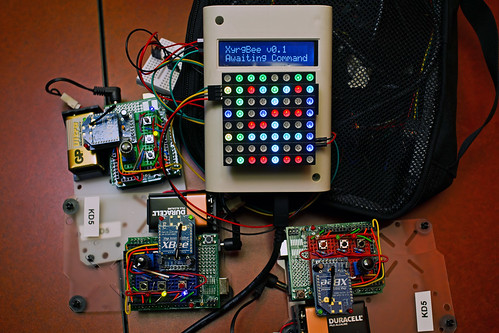
And lastly, if you have a piece of new or “new to you” tech, we invite you to bring it out to the January installment of the Geek Gathering. KD5 and I will be unveiling XyrgBee, a game that began life as a simple idea and has manifest itself in a distributed computing platform, complete with several Arduinos, some wireless communications and a matrix of 192 discrete light emitting diodes flickering faster than your eyes can perceive. That’s right! We’ll have Arduino’s there that are actually DOing something. All of this happens this Friday at 7:00 PM at The Coffee Groundz, located at 2503 Bagby at McGowan in Midtown Houston. Free wifi and geeky conversation abound, complete with a staff offering coffee, beer and wine and a light menu. Hit the Tech Bytes site at www.geekradio.com for details, directions and your own electrifying invitation.

That’s it for your first 4-eleven of twenty-eleven and that’s that for BarretTime.

2010
12.30

Podcast For Dec. 29, 2010

Last show of the year. Last show of the decade.