web analytics
2010
12.30

Techs & Trainers Computer Drive

Techs & Trainers, a Houston non-profit that refurbishes outdated computers to provide up-to-date machines for Houstonians with special needs, is joining with Houston’s Green Bank to hold a computer drive:

To assist with all of the “yesterday’s computers” that Houstonians suddenly have on their hands this week, Green Bank is hosting the computer drop-off at three Houston locations, continuing through Friday, January 7.

During the two week period, Green Bank will accept any unneeded desktops, laptops, monitors, printers and other accessories. Any machines that can’t be repaired will be dismantled for parts and recycled locally, sparing our municipal landfills.

Drop-offs can be made between 9am and 5pm, Mon – Fri, at the following Green Bank locations:

* 4000 Greenbriar (at US 59) – Houston, TX 77098
* Redstone Building, 109 N. Post Oak Lane, Ste. 100 – Houston, TX 77024
* 5018 San Felipe, in the Rice Center – Houston, TX 77056

2010
12.30

BarretTime for December 29, 2010

Allright. This is the last BarretTime of 2010, and it’s not going to be an easy one. I’m going to ask you to look deep into yourselves and into your filesystems, make some tough calls, then actually act on them. While it will take some effort on your part, your soul and your data will thank you.

A point of order before we get underway – this is a non-denominational BarretTime. I’m not here to argue the merits of the different religions: the venerable FAT, the indecipherable NTFS, the kool-aid drinking UFS & HFS-Plus zealots, the solemn ext two through fours, the wonderful XFS, the aging JFS, killer ReiserFS and Styx. Any guesses as to what uses or used Styx? The OS of choice of 70s rock bands? Or the firewall appliance that serves as the boundary between Earth and the Underworld?

A: The Inferno Operating System used Styx, which is actually a variant of the Plan 9 Filesystem Protocol from Bell Labs. That’s metal.

OK – so we’ll wrap up the bit where I’m not mentioning that XFS is the best filesystem on the planet, and we’ll get back to your soul. If the eyes are the window to the soul, then your *desktop* is the window to your *computing* soul. Sorry, Chrome OS users… For those of you with a desktop and a soul: do just a few frequently used shortcuts adorn some cool hand-picked wallpaper? Can you see your wall paper? Do you even remember what it looks like? If you haven’t seen your desktop background image in ages, it may be time to dejunk your desktop. Most operating systems come with existing folders for downloads, documents, images and movies located underneath a user’s home directory. If this isn’t granular enough for you, consider creating subfolders under each of these, like Work and Personal for a start. You can sort the files on your desktop by file type, allowing you to make quick work of going through them, identifying them, and then moving them into the appropriate folder or directory.

Now is also a good time to take a look at installed programs and ask yourself how often you actually use them. Windows will tell you the last date a particular program was used, helping make some difficult decisions easier. Keep in mind that if you are running a Microsoft Windows based operating system and you have done a lot of installing, uninstalling, and re-installing programs throughout the year, you may want to freshen things up with the Jay Lee Maneuver, though the pilgrimage to that temple is one you’ll have to make on your own. Whichever way you go, you’ll wind up with a much more orderly soul, though not necessarily a lighter one. If you really want to soar to the heavens, you’re going to have to trim some of the real weight from your filesystem.

If you have plenty of drive space left, say you’re using less than 50% of your disk, then you’re fine. If, however, you find yourself approaching 80 or even 90%, you may want to search your filesystem to see what’s taking up all the space. Keep in mind that a lot of downloadable software can be downloaded again, especially free packages like Open Office or any Linux Distro, allowing you to delete the original downloaded file. Also, if you have the same files on multiple machines (outside of your backup plan), you can free up some room by removing duplicates. Now, you may have to ask yourself some tough questions like, Do I really need every episode of Battle Star Galactica in HD on every device I own? The answer is yes, by the way, but I’m sure a lot of Linux ISOs and large files can be burned to CD or DVD to free up space just in case Universal decides to make more episodes of BSG.

A note of caution: Unless you truly know what you’re doing, don’t go digging around outside of your personal folders in the hopes of freeing up drive space. If you downloaded it, then by all means delete it, but don’t delve into directories you’re decidedly unfamiliar with. You may think you’re freeing up space by deleting stuff you never look at, like everything in the system32 directory or all of /dev, but in most cases, it’s best not to venture below your own personal directory. That isn’t to say you shouldn’t take a look around; just be careful doing so.

Now that you’re a little lighter, you want to take steps to preserve this new found filesystem freedom by backing up your data to removeable media, another machine or even the cloud. Hopefully, this won’t turn into a do as we say, not as we do, but in 140 characters or less, what backup method or system do each of the hosts use?

The last commandment is to actually test your backups. Once you have your data backed up, see if you can get your files and data extracted from the backups, then actually try to open and use those files. It’s much better to find out that your backup method of choice didn’t perform as you had expected now, when you still have all your data, rather than when the inevitable happens.

So this conveniently leads us into making some New Year’s Resolutions.

My suggestions to you would be:

1) Purge your desktop an all but the bare minimum, moving data files and downloads to their own folders.

2) Do an end-of-the-year backup, and then continue to back up at regular intervals.

3) Test your backups.

My resolution for next year? 1440 by 900.

That’s it for 2010 and that’s that for BarretTime.

2010
12.29

Help Desk A La Carte Pricing Menu

Turn your Help Desk into a profit center with this handy dandy a la carte pricing menu!
*created by Cynthia Lee as a LOL for her company Help Desk.

  • Any problem which can be resolved by simply rebooting your PC.
    $1.00
  • Any problem caused by loose or disconnected cables dangling in plain sight of user.
    $250.00
  • Any problem caused because the cleaning staff inadvertently turned off your power strip.
    $250.00
  • Any problem caused because you allowed your small child, teenager or spouse to use your company PC or laptop.
    $500.00
  • Any problem caused because you changed your password and can’t remember what you changed it to.
    $1,000.00
  • Any problem caused by installing unauthorized software on your company PC or laptop.
    $2,500.00
  • Any problem caused by a virus downloaded along with Internet pornography or “free” movie from Chinese or Russian website.
    $5,000.00
  • Your company laptop or PC has been destroyed because you dropped it in the bathtub, left it outside, spilled coffee or soda on it or drove off with it sitting on the roof of your car.
    $9,500.00
  • Your company laptop or PC has been lost or stolen because you left it in an unlocked car, a restaurant, an airplane or at an airport security checkpoint, or in a hotel room with a prostitute or paid escort.
    $10,000.00
  • 2010
    12.23

    Podcast for December 22, 2010

    Special guest Leo Laporte!

    2010
    12.18

    Podcast for Dec. 15th, 2010

    2010
    12.15

    BarretTime for December 15, 2010

    All right. It’s been 28 years since the original TRON movie hit the big screen. I’ve been intentionally steering clear of any current TRON: Legacy info so as not to run across any spoilers before it opens in theaters this Friday.

    Hopefully, everyone’s familiar with the original storyline, but I’ll keep the next two minutes fairly free of spoilers anyway, just in case there’s anyone out there who’s still 20 or thirty years behind on their movie watching.

    One aspect of the original movie that can be confusing are the pairings between the movie’s analog humans and their digital counterparts.

    The leading role, played by Jeff Bridges – does anyone remember his characters’ names? Kevin Flynn and Clu.

    Alan Bradley’s digital counterpart? Tron.

    Ed Dilliger? Double cast as both Sark and the Master Control Program.

    Lora? Yori.

    and Dr. Walter Gibbs? Dumont.

    You all now know that Jeff Bridges landed the role of Kevin Flynn aka Clu for the first movie, but did you know that Deborah Harry was among the actresses screen tested for the role of Lora, or that Peter O’Toole was approached to play the role of Dillinger/Sark, but became extremely interested in the role of Tron, instead? He suddenly *lost* interest when he found out that the majority of the acting would take place in front of a black screen and that the digital effects would be added later. In fact, many Disney animators refused to work on the film due to fears that computers would replace the skilled pen and ink animators.

    The live action footage inside the world of computers was originally shot in black and white, then colorized in post-production with photographic and rotoscopic techniques. Originally, the good programs were going to have glowing yellow circuitry and the bad programs would glow blue. This was changed before the movie’s release, though if you pay attention to the tank scenes, you’ll notice that some of the original coloring remained in the movie.

    Flashes also appear randomly throughout the film. This was due to a mistake in production and emulsion ordering, but was incorporated into the film by adding corresponding sound effects to make the bright bursts of color appear to be part of the computer world.

    At the time, the computers used in post-production could overlay a digital image onto the film, but lacked the ability to programatically manipulate the images’ position. Animators had to determine the coordinates for the graphic for each frame, and manually key them in. It took 600 coordinates to yield 4 seconds of film showing a light cycle. To aid in this, and to give the computer world a more concrete feel, the film makers nailed the cameras to the floor, stating that the camera was so locked off that “it wouldn’t move even if hit by a car”. Not a budge.

    Other lengths were taken to ensure the proper feel for the film: Jeff Bridge’s costome includes a yoga-like piece worn over the standard Tron unisex body suit. This was done to hide Bridge’s Bulge, making the film more child-friendly.

    Moving on from things you won’t see, to things you may have missed:

    There are a number of Easter Eggs in the original movie. When Tron and Flynn are in the Solar Sailor, an outline of Mickey Mouse can be seen in the landscape below.

    In the scene immediately following the Light Cycle chase, the arcade character Pac Man is shown on Sark’s map and sound effects from the 80s classic can be heard in the background.

    Video Games were ever-present on the set during filming. Bridges would often buy himself enough time to finish a game by claiming that he was preparing for the next scene.

    There’s also a hearty helping of real world computer terms in the movie:

    The Master Control Program uses the phrase “end of line” to terminate conversations with Dillinger. The programs call the programmers “Users”, the dot-like thing that answers yes or no is named “Bit”. Clu, also played by Jeff Bridges, is also the name of a computer programming language developed at MIT between 1974 and 1975. And though the name Tron was originally plucked from the word electronic, there’s no denying the overlap with the BASIC debugging command TRace ON.

    The computer program that helps Tron communicate with his user is named for Allen B Dumont, inventor of the first monitor in 1920. I’m going to start calling mine a montitor in his honor…

    And the character Alan Bradley was named after the Alan-Bradley line of Factory Automation Equipment made by Rockwell Automation. (Just to illustrate how far *they* go back, they have a *two* letter domain name, ab.com.)

    Fiction met reality in many exterior shots. The futuristic Lawrence Livermore Laboratory outside Oakland, California, stood in for the exterior of the Encom facilities. At one point, the lead actress, Cindy Morgan, had to be decontaminated after stepping into a radioactive substance that had spilled outside the facility’s entrance. The Encom programmer cubicles were actual programmer cubes at the Disney Studio and the role of Flynn’s Arcade was played by the historic Hull Building at the Northwest corner of Washington Blvd and Watseka Ave in Culver City, California.

    Despite it’s current cult status, the film was a financial failure; Disney did not attempt another live subject film for another ten years. The Tron *videogame* actually outgrossed the movie, one quarter at a time. We’ll see how the new movie, TRON: Legacy, opening this Friday, fares, but for now, that’s it for your Tron-tastic 0100 0001 0001 and that’s that for BarretTime.

    end of line

    2010
    12.09

    Podcast for Dec. 8th, 2010

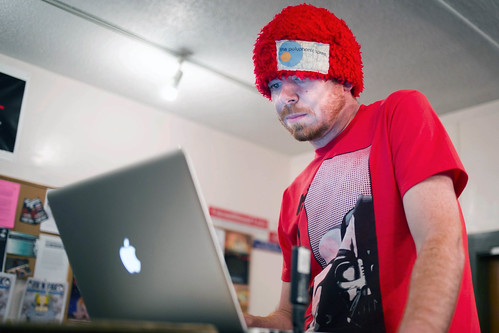
    Barrett Wears A Funny Hat

    2010
    12.02

    Podcast for Dec. 1st, 2010

    2010
    11.29

    Podcast For Nov. 24th, 2010

    2010
    11.24

    BarretTime for November 24, 2010

    All right. It’s Thanksgiving Eve and thousands of geek bodies are relatively tryptophan free before the big day. Sir Frederick Hopkins, who won the Nobel Prize in Physiology or Medicine for the discovery of vitamins, was the first person to isolate the standard amino acid in 1901. Since then, tryptophan has been discovered to be a precursor for serotonin, melatonin and niacin by the scientific community, and is often purported as being a precursor to periods of drowsiness and, in some cases, naps, by the Thanksgiving community.

    Now, it *is* true that large amounts of Tryptophan *can* have adverse effects on humans. Things like Eosinophilia-myalgia-syndrome, aka EMS, which includes symptoms such as severe muscle pain, fatigue, nerve pain, hair loss, a rash, and dry thickened skin, have been potentially linked to large intake of L-Tryptophan dietary supplements. Serotonin syndrome can also be a risk, signs of which include confusion, hallucinations, a fast heartbeat, feeling faint, a fever, sweating, muscle spasms and difficulty walking. Before you roust your elderly uncle from the armchair en route to the hospital, know that the levels of tryptophan in turkey are typical of most poultry
    and that foods like chocolate, oats, dried dates, milk, yogurt, cottage cheese, red meat, fish, eggs, spirulina and even peanuts are just as high in tryptophan as turkey, if not higher. The amount of turkey you would have to eat to near tryptophan toxicity is scary, with most cases of EMS being reported by those taking large amounts of tryptophan as a health supplement. In fact the Annals of Pharmacotherapy report the main treatment method of EMS as the discontinuation of tryptophan ingestion. So if you start to experience sudden hair loss and feel faint of heart, put the turkey leg down.

    Having been misinformed as to the actual severity of the Tryptophan threat, HAL-PC has cancelled a number of Special Interest Group meetings this weekend. On Thursday, both the Laptop Investors and the A+ Skills and Drills meetings have been canceled. Friday’s PC Upgrade and Troubleshooting SIG has been shot, and the Microsoft Server SIG has crashed. New Members will be left disoriented later that evening, and on Saturday the GETTraders will have gotten elsewhere. The Linux SIG has not been canceled, but will be offline from two to four Saturday afternoon for a scheduled maintenance window, thus preserving their precious up time. And while autonomous robots are welcome to show up for the Robotics SIG, the humans will not be there to let them in. Hit www.hal-pc.org for a full schedule of canceled events.

    The following Monday and Tuesday are the fifth of each in the month, so there’s really not much going on in terms of tech meet-ups for nearly another week. All the true tech action will be carried out in the shopping carts of web surfers around the nation on Black Friday and Cyber Monday.

    The National Retail Federation reported that 96.5 million Americans shopped online last Cyber Monday compared to just 79 million of their brick-and-mortar counterparts the black Friday before. If you do plan to get in on the online action this year, try to do so from your own home network rather than a public WiFi hot spot or crowded coffee shop. If you haven’t done so already, it’s probably a good time to install HTTPS Everywhere from the Electronic Frontier Foundation. The Firefox browser add-on can be installed from the group’s website at https://www.eff.org/https-everywhere. While many sites support the HTTPS protocol, most will not automatically re-direct you to the secure means of communicating with the site. HTTPS everywhere tries to bridge that gap until websites begin to take more responsibility for the security of their surfers.

    While you’re at it, make sure that you’ve have a reputable Anti-Virus package installed and are current with all updates and virus definitions. If a new registration is required to make a purchase, be sure to review the sites Privacy Policy before handing over all of your personally identifying information. And when it comes time to pay, remember that Federal Law gives Credit Card users some protection in that it allows them to dispute the charges if the ordered item is not received. When it comes time to key in the sixteen digits, be sure that your browser has the secure HTTPS lock displayed or that https appears in the browser address bar rather than the standard http. Remember that the S stands for Secure, and you’ll definitely want to look for this before you enter any personal information at all. Some browsers also offer warnings when visiting a website suspected of phishing. And lastly, keep records of your purchases in the form of screen shots of saved web pages, and be sure to check your credit card and bank statements after the fact to make sure that all the charges are correct and that there aren’t any surprises that you didn’t authorize. When it comes to online shopping, an ounce of prevention is worth a terabyte of cure.

    That’s it for your pre-turkey-day tryptophan tear-down and that’s that for BarretTime.