web analytics
2010
06.03

Podcast For June 2nd, 2010

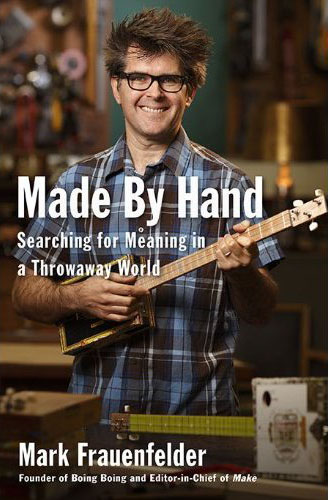
Tonight’s show featured an interview with Mark Frauenfelder, co-founder of bOING bOING and editor-in-chief of MAKE magazine.

Mark joined us to discuss his book MADE BY HAND: Searching for Meaning in a Throwaway World.

“Frauenfelder has been at the center of the emerging maker movement, chronicling its rise as an economic force. Here, he describes a parallel evolution: his own embrace of making, as he applies the lessons he’s been learning to his own life. It’s as inspiring as it is entertaining. You’ll never look at your lawn the same again!”
– Chris Anderson, Editor in Chief, Wired Magazine

The interview begins around the 30 minute mark (8:30 central time) of the podcast. If you just want to hear the interview with Mark, you can download it here.

2010
06.02

BarretTime for June 2, 2010

All right. We’re finally free of those awkward moments where you were either squirming around in your chair or stepping up to support KPFT. I, for one, am extremely glad its over. For those of you who are now helping keep KPFT on the air, we thank you. For the squirmers: There’s always a second chance. Assuming we keep meeting our goals.

So, not due to any shortcomings in listener support, but rather in order to take a bit of a breather before the big plunge, we will *not* be holding the monthly Geek Gathering this Friday in anticipation of the 15th Anniversary Party at the Foundation Room at the Houston House of Blues in July. This is going to be big. Given the potential light levels, I’m sure we’ll be doing something with a lot of LEDs and Arduinos. And if you’d like to get in on some of the action rather than being a casual bystander mesmerized by all the blinky lights, then you may want to make plans to attend the 2010 edition of Apollocon, Houston’s Science Fiction, Fantasy and Horror Conference. Aside from the usual goings-on, friend of KD5 and I will be putting on a presentation on Arduino and Open Source Hardware along with a workshop in which participants can build their own arduino and get some lights blinking in anticipation of the big 15. The weekend of June 26th is the one you’ll want to keep free. Details on the con can be found at www.apollocon.org, with details about the Arduino panel and workshop once they’re nailed down. But for now, back to being excited about our party.

I think we have the venue until 2:00 AM, so you may not be getting up very early the next morning. Which could be a problem, because it’s often been said that you have to wake up pretty early in the morning to get a jump on the crew of Technology Bytes in terms of pure troubleshooting prowess. Given, we were probably the ones saying it, but until now we have never mentioned an exact time. And the time is… Drum Roll… Huh. 9:30 AM. I really thought it would be earlier. Well, you may have to get up closer to 8:30, depending on traffic between you and the PC Upgrade and Troubleshooting SIG at the HAL-PC Headquarters, which is located at 4543 Post Oak Place Drive. That’s just off the West Loop and San Felipe, conveniently close to corporate coffee in case 9:30 AM really does come early for you. The SIG happens every Friday morning from 9:30 to 11:30, so, actually it’s: You have to get to work pretty late to get a jump on the crew of technology bytes. How’s that for a catch-phrase?

The PC Upgrade & Troubleshooting Workshop specializes in helping HAL-PC members get their misbehaving computers back in good working order. You’re free to come watch the HAL-PC members help others in distress, but you’ll have to be a member to get your computer looked at. Even then, you need to make an appointment with the HAL-PC Front Desk and most of the six available slots fill up by Tuesday. Suddenly our on-hold times don’t seem so bad. That would be the equivalent of Richard on LINE 2 having had to have called in last Sunday night. That’s not a dig at HAL-PC, just something for the squirmers to think about until next time.

Other opportunities to up your technical game exist at HAL-PC. This Saturday, June 5th, the Samba & Network Administration SIG meets at two in the afternoon at the HAL-PC Headquarters. Samba is the free software program that allows Linux and Unix based computers to join MS Workgroups and Domains and even host Windows file shares. Rick Archibald will be leading the group through Samba 3 by Example while also tackling hybrid and open source networking. And just like the Wednesday Linux Workshop, its always free to attend.

The Linux Workshop meets from six to eight every Wednesday night at the HAL-PC HQ, and, unlike the PC Upgrade and Troubleshooting Workshop, you don’t have to book anything in advance or even be a member, though membership is generally encouraged. Wether you’re looking to hone your existing Linux skills or if you’re a complete noob and you would like to have every detail of Linux’s history played out for your ears, the Linux workshop is for you. If you get this explanation unsolicited, you can always ask them a Windows question under the guise of running Win4Lin, WINE, or some other Linux emulation package. The cons are low on this one and the Pros include not having to get up early, probably not having to miss any work, and definitely not missing any Technology Bytes.

You can find more information on these and several other Special Interest Groups by surfing to www.hal-pc.org and checking out the SIG calendar.

That’s it for me for the next two weeks and that’s that for BarretTime.

2010
06.02

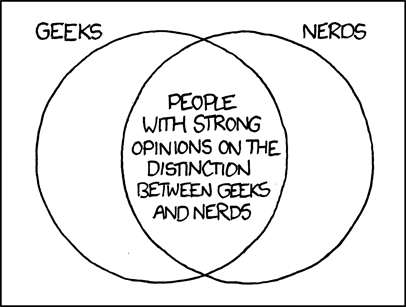
xkcd Venn Diagram on Geeks & Nerds

2010
05.31

Podcast for May 26th, 2010

2010
05.22

Podcast for May 19th, 2010

Still in fund raising mode

2010
05.22

Podcast for May 12th, 2010

We’re in fund raising mode.

2010
05.19

BarretTime for May 19, 2010

“….a towel has immense psychological value. For some reason, if a strag (strag: nonhitchhiker) discovers that a hitchhiker has his towel with him, he will automatically assume that he is also in possession of a toothbrush, washcloth, soap, tin of biscuits, flask, compass, map, ball of string, gnat spray, wet-weather gear, space suit etc., etc. Furthermore, the strag will then happily lend the hitchhiker any of these or a dozen other items that the hitchhiker might accidentally have “lost”. What the strag will think is that any man who can hitch the length and breadth of the galaxy, rough it, slum it, struggle against terrible odds, win through, and still knows where his towel is, is clearly a man to be reckoned with.”

I think that most of you will recognize that passage from the late author Douglas Adams, creator of the Hitchhikers Guide to the Galaxy series of works. Douglas Adams passed on May 11, 2001, and on Tuesday, May 25th, people around the world will honor the author by taking their towel with them wherever the day may take them. If you want to find some fellow hitchhikers to revel with or get some more history on the event, you can surf to www.towelday.org.

And if you’re plugged into the Internet right now, chances are extremely good that your data is traveling through an Ethernet cable along some point of its journey. Ethernet, the thought child of Robert Metcalfe, will have been around 37 years as of this Saturday, May 22nd.

Ethernet has enjoyed nearly two decades of supremacy as the de facto way to connect computers together in a home or office. It wasn’t until the recent widespread adoption of wireless technologies that the Ethernet cable started becoming an afterthought in people’s laptop bags and backpacks.

I’m curious as to how many of us in the studio could actually produce an Ethernet cable from their laptop bags right now… Anyone?

Most people are wireless these days, and since Kaveh Kanes closed, I know of no coffee shop in Houston where I can show up with a 20 foot Ethernet cable and expect to get connectivity. Of the two, Wireless is actually the more venerable technology, though, with Ethernet borrowing some of its tricks from one of the very first wireless networks that was created to connect several University of Hawaii computers together in 1970.

This network, the aptly named Alohanet, used amateur radio to link nodes together. Using one frequency to transmit and another to receive, a machine receiving data would immediately re-transmit that data back the origin machine, thus introducing the ability to detect and correct errors during transmission. Aloha also tackled the issue of collision detection, a condition when two computers try to talk at the same time, by just dropping both transmissions and simply trying again. Transfer speeds on Alohanet maxed out the Data Terminal Equipments built-in baud rate of 80 words per minute. That’s Teletype speed for you old timers…

Another networking technology was coming on very strong in the 70s that may have displaced Ethernet if not for one single flaw. IBM’s token ring technology overcame the problem of collisions by using a 3-byte token that was virtually passed between computers connected in a ring pattern. Only the computer in possession of the token was allowed to talk, or transmit data, while all other remained quiet. This ruled out the possibility of data collision. Token Ring speeds kept up with Ethernet speeds, with IBMs 16 MB/s Token Ring technology being introduced in 1989, eventually becoming the IEEE standard for token ring networks. Both Apollo Computer and Proteon offered other proprietary token schemes in the 80s. And though IBM did beat out those companies, it was Token Ring’s large plastic connectors and thick IBM Type 1 cabling that kept it from overtaking Ethernet. Token Ring speeds eventually hit 100MB/s, but would never see the multi-Gigabit Ethernet speeds realized today.

Early Ethernet cabling looked a lot like the coaxial cable that used to bring cable television into homes before satellite hit the scene. Now, Ethernet cabling takes the form of 4 twisted pairs of wire sheathed in a plastic coating. The end connectors are known as RJ-45 connectors, a larger version of what you still find on the ends of phone cabling, which is known as RJ-11.

So happy 37, Ethernet!

That’s exactly the half-way-point of this season’s sizzle and that’s that for BarretTime.

2010
05.19

iPad Commercial a Tribute to the Newton

The original Newton commercial circa 1993

The iPad commercial

2010
05.17

Be a Theatre Geek @ The Alley

The Alley Theater has been kind enough to offer all geeks a discount on tickets to their production of Intelligence-Slave, a new play by Kenneth Lin. Here’s a PDF with all the necessary info.

2010
05.14

It’s fund raising time again, so there’s no avoiding tuning into talk that expresses the cost of a KPFT membership in equivalent units of other stuff. Like a cup of coffee. Whether is was the five-cents-a-day fare that Sally Struthers spoke of before the age of Star Bucks or the proverbial four dollar frappachino, that calculation is rarely omitted from fund raising efforts. Possibly because it’s easy math…and nearly everyone in the geekosphere can relate to caffeine.

And you certainly wouldn’t want to have to figure out what a KPFT Basic Membership would cost you in terms of terabytes transferred to Amazon’s Simple Storage Solution if you had to do it by hand, would you? Especially if they’re computing megabytes as a powers of two rather than the mega-means-one-thousand bytes methodology that is extremely popular with hard drive manufacturers.

No, you would want, maybe even *need*, a calculator.

Blaise Pascal is generally credited with inventing the digital calculator. And by digital, I mean a technology that uses discrete values rather electronic. I have seen some misinformed folk on the ‘net under the impression that Blaise was typing out 55378008 to elicit giggles from friends. That is simply not the case. Blaise’s calculator, known as the Pascaline, was a collection of eight movable dials, each one representing a power of ten. So as the first dial representing the numbers zero through nine would make one full revolution, it would move the second wheel, representing the tens, one click.

This was actually an improvement on the Slide Rule, which was invented in 1622 by William Oughtred. Early-day slide rules came in both rectangular *and* circular models. An engineer with a slide rule is his pocket is probably a pretty old engineer; an engineer with a circular slide rule is ancient.

In 1820, the Arithmometer came on the scene. It was the first commercially successful mechanical calculator.

In 1886, the Comptometer became the first successful key-driven adding machine.

In 1878, W.T. Odhner introduced the Odhner Arithmometer that improved on the earlier device with the addition of a pinwheel engine.

And in 1893, The “Millionare” calculator was introduced. It was the first in its class to perform direct multiplication. Snopes neither confirmed nor denied that these early calculators were, in fact, covered with gold.

Other cool calculated names? The Arithmaurel in 1842 and the curtly name Curta. The Curta was the first miniature calculator that could be held in one hand. And while it was introduced to the world in 1948, it was developed under peculiar circumstances in 1938.

These circumstances included Nazi’s bunkered away in underground salt mines, forcing a Mr. Curt Herzstark (Spoiler Alert: the Curta) to work on a small, black metal cylinder, no bigger than the palm of his hand.

If you want to know more, you can Go Googling or you can check out the story re-enacted by real live people on the Neuhaus stage of the Alley Theater.

They’ll be putting on Kenneth Lin’s play, Intelligence-Slave, which centers around Curt, his work on the world’s first miniature four function calculator and his dealings with the nasty Nazi’s that designated him an intelligence slave during the second World War.

The play runs from May 23 through June 20th here in Houston at the Alley Theater. It’s actually the play’s world premier, otherwise I would rattle off some reviews for you. You hear that, bloggers? This is brand new territory…

Another spoiler alert? You can spell Sieg Heil using the same upside-down technique on any pocket calculator with an LCD disply. Actually, I’m not entirely sure that’s in the play; I’ve only read the first act. I do know that the cast has spent some time with an actual Curta device so they would be able to more accurately operate the prop-Curta on stage.

For details on the play and performance times, hit www.alleytheatre.org. (Either spelling of theater works with that…)

A warning: The play is recommended for mature audiences due to “language and subject matter”. I’m assuming this mature subject matter is the math behind 9’s Compliment, not the Nazis. Nine’s Compliment is the notion that you can perform subtraction operations by adding the radix compliment, or in our own decimal system, the Nine’s compliment of a number.

If you want some Allied Action, you’ll have to search out Hugh Whitemore’s play, Breaking the Code, which centers around Alan Turing and his efforts to break the German Enigma code at Bletchley Park during World War II. The play was adapted for television in 1996 by the BBC and was re-broadcast in the US by PBS, so there’s a good chance you can find it.

While that’s not certainly not it for this calculated cry for currency, that that’s for BarretTime.