web analytics
2007
03.09

This Sunday morning, many of us will be setting our clocks ahead 1 hour for Daylight Savings Time.

What makes this different than last spring is that, thanks to the Energy Policy Act of 2005, Daylight Savings Time will start on the second Sunday in March (March 11, 2007) instead of the first Sunday in April (April 1, 2007).

Why is this a technology story? Most computer operating systems are programmed to know when Daylight Savings time is supposed to happen. That way they can update the system time and allow computers and applications to know what time it is, even after a time change.

Since the time change has now been rescheduled, many computer operating systems — along with PDA’s, Blackberries, cell phones and yes, even self correcting alarm clocks and VCR’s — won’t know to change times when Daylight Savings Time occurs this year.

Microsoft has issued a patch for Windows XP and Windows Server 2003, which should have installed on your computer already if you have been keeping up with your updates. If not, you can download it here. Windows Vista is not affected.

While there are no official updates for Windows 2000, Microsoft offers a tool that can be downloaded here which will walk you through updating Windows 2000 manually, as well as all versions of XP and Server 2003. There’s also a tool there to verify your version of Vista just in case.

For you Apple users, DST rule changes for the United States and most of Canada are already available in Mac OS X 10.4.5 or later. Apple is providing software updates for Mac OS X 10.3, 10.4 and later. To make sure that your clock maintains the proper time, simply install the updates that are shown for your computer in Software Update

Owners of devices that run Windows Mobile will also need to update their software. You can find instructions for that here. This includes devices like the Treo, T-Mobile Dash and any other Smart Phone devices that run the Windows Mobile Operating System.

Research in Motion has issued a patch for its BlackBerry devices available at this site, so if you use a BlackBerry you might want to check that out.

Java developers and those who maintain any type of Java based application should also be aware that this time change can affect the Java Runtime Environment as well. Sun outlines this on this web site.

There are no patches available for users of Microsoft Windows 95, Microsoft Windows 98, Microsoft Windows Second Edition, Microsoft Windows ME and Microsoft Windows NT 4. You will need to change your system clock manually and likely again if it auto-corrects when the time change is typically scheduled.

Owners of devices that run the Palm OS should consult the Palm OS site for any updates your device might require.

Other devices not listed here may be affected. Read this Wikipedia article for more details on affected systems.

If you have a device that you think might be affected, check with the manufacturer to verify.

It’s not the end of the world. The worst case scenarios tend to be computer calendar appointments being off by an hour but there could be more serious effects if certain automated processes fire off an hour later than they are supposed to.

Good luck! See you after the time change!

Jay Lee
www.baldheretic.com

*EDIT*

Additional information from my friend Bob Entwhistle:

Additional information:

These folks have created unofficial patches for Win2K/NT/98/ME.

This article has a bunch of links to Linux/Unix patches.

Here’s the page for Mandriva that will guide you to their patches.

MandrivaUpdate downloads this automatically.

This command will indicate if you need a patch:
sudo zdump -v /etc/localtime | grep 2007

Here’s a guide for Ubuntu, presumably if you’re not automatically downloading updates. This should work for other Linuxes, also.

2007
03.08

Podcast March 7, 2007

2007
03.07

DST Domesday

While Benjamin Franklin may have been first to suggest saving daylight in
1784, he made no mention Daylight Saving Time (DST). It was William Willett
who first officially proposed DST to the British government, though he was
unable to convince Parliment to adopt it. Though often referred to as “summer
time” in British English, it was the Germans (during World War One, no less)
who first put DST into practice, choosing the initial dates of April 30th,
1916, through October 1st, 1916. Not to be outdone, the Brits followed suit,
first adopting it between May 21st and October 1st, 1916. Newfoundland lead
North America in the charge, and in March of 1918, the U.S. Congress
established DST from the last Sunday in March to the last Sunday in October,
only to have Congress repeal it in 1919. President Woodrow Wilson vetoed the
repeal, but Congress overrode it. Despite the very American proverb, “Early
to bed, early to rise,” American’s don’t like to be told to get out of bed
any earlier than they have to…

Everything ticked right along until August 8, 2005, when President George W.
Bush signed the Energy Policy Act of 2005. This Act changed the time change
dates for Daylight Saving Time in the US. Beginning this year, DST will begin
on the second Sunday in March and end the first Sunday in November.

This gives us a new term: Y2K7

Y2K7 refers to the Year 2007 problem, caused by this US-mandated change to
Daylight Saving Time, which could have widespread repercussions in the
computer industry.

Any device that automatically corrects its clock to match the time changes to
Daylight Saving Time, such as a personal computers or VCR, now needs to be
updated so that the device knows of the new rules. If the devices are not
updated, they will show an incorrect time for three weeks in March and one
week in November, and cause a number of problems including having e-mail with
incorrect timestamps, events in calendaring software being displayed
incorrectly and some authentication software, such as Kerberos in Mac OS, not
behaving properly.[1] To avoid these problems users either have to update
their devices manually when Daylight Saving Time changes, or update their
software to newer versions.

If you want to know how to do that, wikipedia has a fairly exhaustive list of
updates for various Operating systems, from i5/OS to Mac OS 10.5. You can
find this page by googling for y2k7 and wikipedia.

Incidentally, the band Coldplay’s song “Clocks” was co-written by Chris
Martin, great-great grandson of DST inventor William Willett.

That’s it for your dose of DST deliverance and thats that for BarretTime.

2007
03.07

InfoShot – March 7, 2007

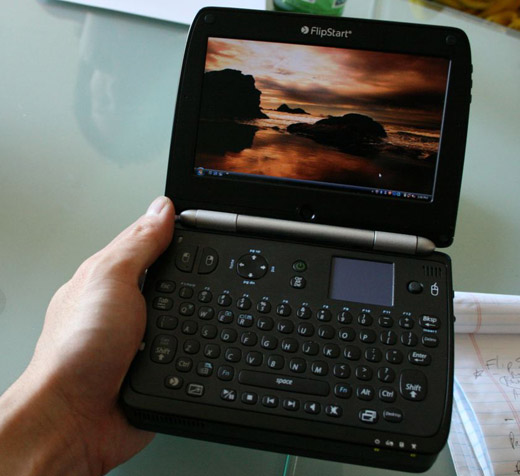
Vulcan Flipstart

Wired News: Tech Researchers Calculate Digital Info…

CNET News: Intruder adds back door to WordPress blog software…

The Register: Man sues MS after FBI uncovers smut surfing habits…

Gizmodo: Golf Ball Launcher Makes Golf Fun for All…

Gizmodo: Vulcan FlipStart E-1001S: Vaporware, Four Years Later

2007
03.06

Changing the website

On March 6 we made a number of changes to the website. We will still be tweaking for a few days. If you see something that looks like a problem or have a suggestion, email peter@geekcom.com with the URL and a description of the problem.

2007
03.06

Podcast: Feb. 28, 2007

Site for optical communication

2007
02.26

The Slanket

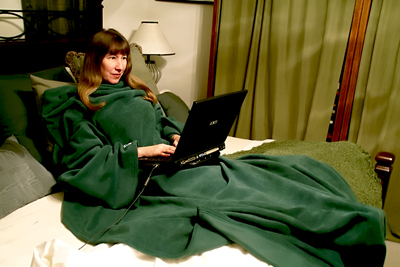
Just last week I was introduced to The Slanket. Not since the invention of the electric blanket has there been a more exciting development in blanket technology.

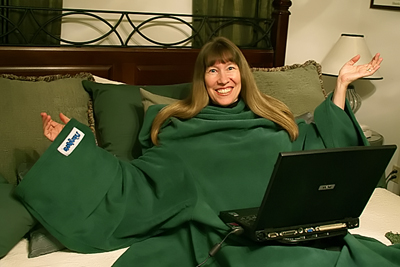
The Slanket is a Gigantic fleece blanket with loose, over-sized sleeves so you never feel constricted and you have total control of how to use them, while staying toasty. The Slanket is made of a thick and warm 310 gsm fleece that feels very soft on the skin. The Slanket is great on a couch, a chair, in a hammock, on your bed or anywhere else you care to take it.

The true test of The Slanket was giving it to my wife, Cynthia, to try out. She appreciates nothing more than being warm and comfortable. Here you can see her wrapped snugly in her new Slanket as she surfs the web shopping her favorite website, amazon.com.

slanketfull-small.jpg

She’s having no trouble at all spending our life savings on books as she remains comfy and cozy with her Slanket.

The Slanket is not a poncho or a sweatshirt or anything like that. It’s simply a well made blanket with sleeves. The sleeves enable you to keep warm while reading, playing your new Wii or Sony Playstation or just casually flipping through the TV channels using your remote.

slanketarms-small.jpg

Machine washable, durable and oh so comfortable.
Cynthia says she cannot imagine life without it and refuses to give it back to me.

2006
12.14

Tao Digital Picture Keychain

In these on-line times we live in, who doesn’t have a Flickr account or access any number of online image hosting services?
Whether we want to share pictures with our friends and loved ones or just peruse the works of others the Internet has made it possible to connect instantly to a visual world chock full of digital imagery.

But what about those times you don’t have access to the web? What then?

Consider theTao Digital Picture Keychain.

This Handy little device is about the size of car alarm key fob and has the ability to store 56 digital images uploaded from your computer that you can then carry with you anywhere.

The Tao Digital Picture Keychain would make a great stocking stuffer for the gadget geek in your family.

2006
11.02

InfoShot: 11/1/2006 – Fund Drive edition

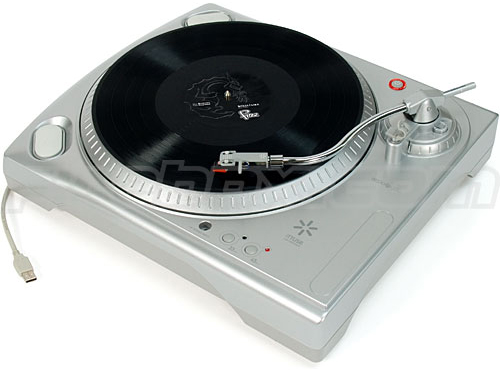
USB turntableThe Register: Bot nets likely behind jump in spam
So if you don’t stop spyware, your computer might be part of the botnets…

CNet: NASA opts for Hubble rescue mission
Keeping the stellar photo goodness alive…

CNet: Dell puts AMD-powered notebooks on sale
Putting a toe over to the AMD-side…

Gizmodo: USB Turntable Simplifies Vinyl Ripping
Finally, a useful new USB device…

2006
09.27

InfoShot – 9/27/2006 – High tech VW Bus

VW Bus

CNET News: Study: Tech unites, not divides ‘Family 2.0’

BBC News: ‘Tower of Babel’ technology nears

Think Secret: Apple iPhone to be Cingular-exclusive at launch

SanDisk Announces 16 GB CompactFlash Card

Sharp’s triple veil-view LCD

Jalopnik: A New Old Bus: Volkswagen Updates a 1964 Microbus with Gadgets

Got any tips? email peter@geekradio.com